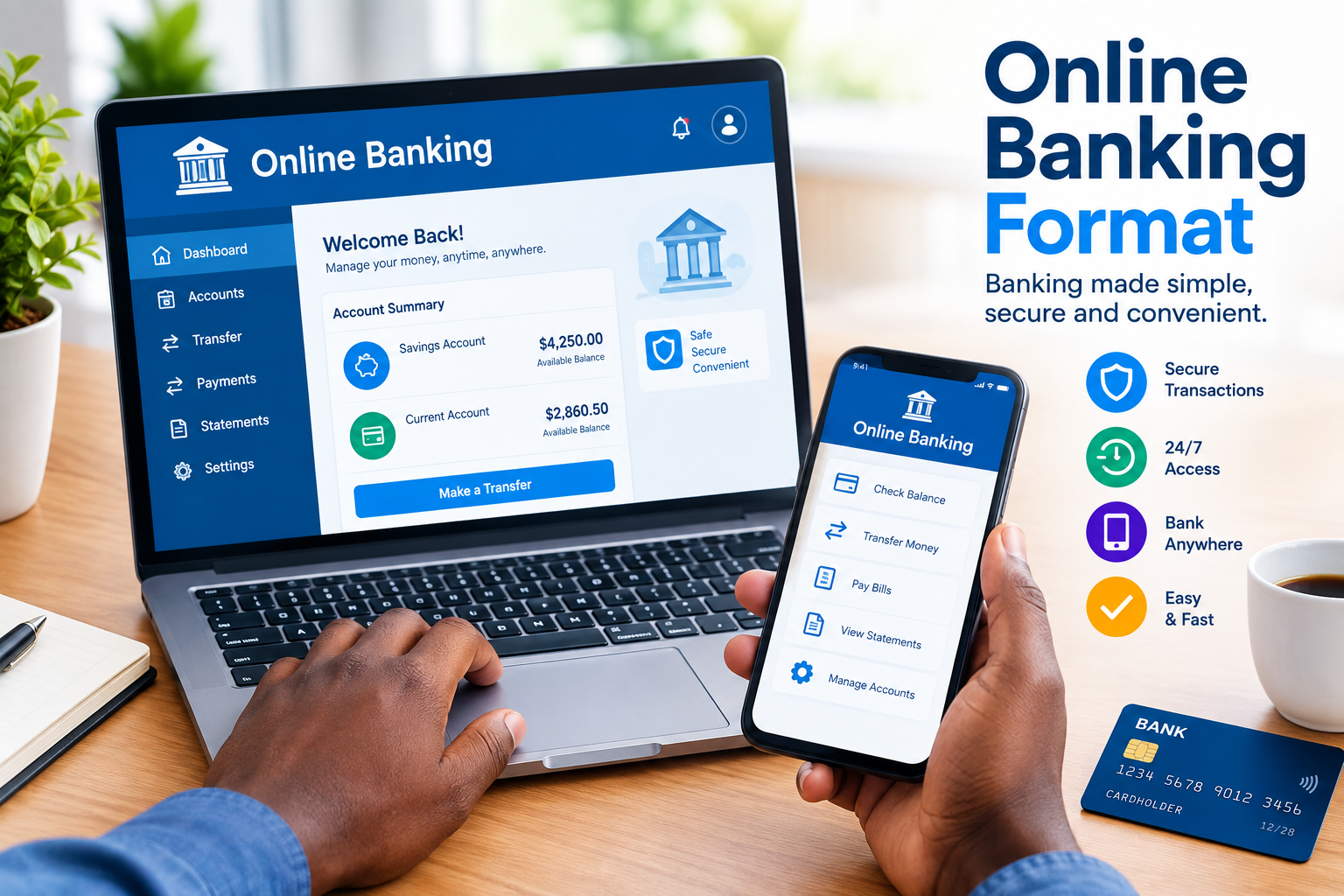
Online Banking Format For Client is our topic for today, at the end of this post you will get a detailed knowledge on what online banking format is all about, keep reading.
Click Here To Read Full Detailed Online Banking Articles
Introduction
Online banking has changed the way people manage their money. Instead of visiting a bank branch for every transaction, customers can now check account information, review transactions, make payments, and manage their finances through digital banking platforms.
Do You Need A Website For Your Business? Contact Devphiliplab On WhatsApp 08151796265
As online banking becomes more common, people may come across the term online banking format. But what does it actually mean?
An online banking format generally refers to the way banking information is organized and displayed digitally. It can describe the layout of information such as account details, transaction history, balances, payment information, and other financial records.
Read Also: Consignment Format for Client
Online Banking Format
In this guide, we will explain what an online banking format means, the information it may contain, how it can be structured, and important safety considerations when creating or using one.
What Is an Online Banking Format?
An online banking format is a structured way of presenting banking-related information in a digital document, webpage, application, or financial record.
The format is designed to make information easy to read and understand. Depending on its purpose, it may contain details such as an account holder’s name, transaction dates, transaction descriptions, account balance, and other relevant information.
A real bank may use its own design and formatting for online banking statements and dashboards. Therefore, there is no single universal online banking format used by every financial institution.
For personal projects, educational materials, software demonstrations, or business recordkeeping, a generic banking format can be created without copying the branding or appearance of a real financial institution.
Why Is an Online Banking Format Important?
A clear format makes financial information easier to organize and review.
For example, a well structured digital banking record can help a user quickly identify:
- Account information
- Transaction dates
- Deposits and withdrawals
- Payments
- Available balance
- Transaction descriptions
- Reference numbers
- Account activity
Good organization can reduce confusion and make it easier to find specific information.
Businesses can also use structured financial records to keep internal records organized, while developers may use generic banking interfaces when designing financial applications.
Common Sections in an Online Banking Format
Although formats differ between banks and financial applications, several sections are commonly found in digital banking records.
1: Account Information
The account information section identifies the account associated with the record.
It may include:
- Account holder name
- Account type
- Partially masked account number
- Currency
- Statement period
For privacy reasons, sensitive account information should not be displayed unnecessarily.
2: Account Balance
A banking format may show the balance available in an account.
Depending on the system, there may be different types of balances, including current balance, available balance, or pending balance.
Clearly labeling each balance helps users understand what the figures represent.
3: Transaction History
Transaction history is one of the most important parts of an online banking format.
The information above is only an illustrative example. It should not be presented as an authentic bank statement.
4: Transaction Description
A transaction description explains what a transaction represents.
For example, a legitimate financial record might identify a payment, transfer, deposit, withdrawal, or fee.
Descriptions should be clear enough for the account holder to understand the purpose of the transaction.
5: Reference Information
Some banking systems provide a transaction reference or identification number.
These references can help customers and financial institutions locate a particular transaction when resolving an issue.
When creating sample documents for educational or design purposes, fictional reference numbers should be used rather than real financial information.
How to Create a Simple Online Banking Format
Creating a generic online banking format starts with deciding what information the document needs to communicate.
Step 1: Define the Purpose
First, determine why the format is being created.
It could be intended for:
- A software prototype
- An educational project
- A financial management application
- Internal business recordkeeping
- A user-interface design
- A fictional demonstration
The purpose determines what information should be included.
Step 2: Organize the Information
Place related information into logical sections.
For example, account information can appear at the top, followed by balances and transaction history.
A simple structure could look like this:
Account Information
Account Holder: Example User
Account Type: Personal Account
Currency: EUR
Account Summary
Current Balance: €1,200.00
Transaction History
Date | Description | Amount | Balance
This structure is simple and easy to understand.
Step 3: Use Clear Labels
Every section should have a clear label.
Instead of using complicated terminology, use familiar terms such as “Account Balance,” “Transaction Date,” “Description,” and “Amount.”
Clear labels make the format easier for different users to understand.
Step 4: Protect Sensitive Information
Financial information is private and should be handled carefully.
Avoid publishing complete account numbers, passwords, PINs, security codes, or other confidential information.
When demonstrating a banking format online, use fictional information or mask sensitive fields.
For example:
Account Number: XXXX XXXX 1234
This is safer than displaying a complete account number.
Online Banking Format for Websites and Applications
Developers may use generic online banking formats when designing financial websites or applications.
A dashboard could include sections for account summaries, recent activity, payments, transfers, notifications, and account settings.
However, a demonstration interface should be clearly identified as a sample or prototype when appropriate. It should not be designed to deceive users into believing that it is an official page belonging to a real financial institution.
If a banking application will handle real money or financial information, additional security, regulatory, authentication, and data-protection requirements may apply.
Difference Between an Online Banking Format and a Bank Statement
An online banking format and a bank statement are not necessarily the same thing.
An online banking format generally describes how banking information is arranged or displayed digitally.
A bank statement is an official financial document issued by a bank or financial institution showing account activity for a particular period.
A sample or template should never be represented as an official statement issued by a financial institution.
Safety Tips When Using Online Banking Formats
Online financial information should always be handled carefully.
Here are some important safety practices:
- Never share your online banking password.
- Avoid publishing complete account numbers.
- Do not share PINs or security codes.
- Use secure websites and applications.
- Check transaction details carefully.
- Keep your banking applications updated.
- Be cautious of unexpected payment requests.
- Verify financial documents through the issuing institution when necessary.
If you receive a suspicious banking document, contact your financial institution through an official communication channel.
Frequently Asked Questions
What is an online banking format?
An online banking format is a structured way of displaying banking-related information digitally. It can include account details, balances, transactions, and other financial information.
Can I create an online banking format?
Yes. A generic format can be created for educational, design, software development, or legitimate recordkeeping purposes. Use fictional information when creating demonstrations.
Is an online banking format the same as a bank statement?
No. A bank statement is an official record issued by a financial institution, while an online banking format can simply describe the structure or presentation of banking information.
What information should an online banking format contain?
Depending on its purpose, it may contain account information, transaction dates, descriptions, amounts, balances, and reference information.
Is it safe to share an online banking format?
It depends on what information it contains. Never publicly share passwords, PINs, security codes, or unnecessary personal financial information.
Contact Devphiliplab on WhatsApp Here
if you need Online Banking website
Conclusion
An online banking format provides a structured way to organize and display financial information digitally. A well-designed format can make account information, balances, and transaction history easier to understand.
Whether you are creating a website prototype, designing a financial application, preparing educational material, or organizing legitimate business records, clarity and privacy should remain important considerations.
Most importantly, sample banking formats should be clearly distinguished from authentic documents issued by financial institutions. Always use fictional information for demonstrations and protect real financial data from unnecessary exposure.
With a simple structure, clear labels, and appropriate privacy measures, an online banking format can present financial information in a professional and easy-to-understand way.